
Disability and libraries: tips for overcoming the most common barriers
Tools, spaces, and skills for a more accessible library
Libraries can seem very distant from the reality of those with visual disabilities: the lack of adequate aids or trained staff risks making them unwelcoming, to the detriment of the many blind and visually impaired people who love to read.
Yet, reading is an activity accessible even to those who cannot see or see little. Those born blind use braille, a code made up of six dots whose combinations form letters and numbers, while visually impaired people can use large print books. In Italy, these materials are mainly provided by the Biblioteca Italiana per Ciechi “Regina Margherita”. In addition to these tools, especially for the little ones, tactile books are very effective, allowing the understanding of complex or abstract concepts, such as the projection of shadows or perspective.
In recent years, new technologies have further expanded access to reading opportunities. Today it is possible to read, study and get informed thanks to speech synthesis, which converts content on any device into audio. Alternatively, one can listen to the voice of artificial intelligence, increasingly natural, or that of professional actors who perform audiobooks, now widespread and appreciated even by those without disabilities. A significant example is the "Libro Parlato Online" app, provided by the Italian Union of the Blind and Visually Impaired, which offers a vast catalog of works.
Faced with these opportunities, it is natural to ask what role libraries play today and how they can continue to attract users with specific needs. If technology allows access to content anywhere, why go physically to the library?
The answer lies in the very nature of these places. Libraries are not only consultation spaces but environments where, even in silence and tranquility, it is possible to cultivate interests and passions together with other people. They therefore represent an important social reference point, capable of fostering meeting, sharing, and a sense of belonging to the community.
In this perspective, accessibility becomes a fundamental element. In recent years, also thanks to PNRR funds, many libraries and archives have started a renewal process, equipping themselves with tools and aids that allow more inclusive enjoyment of the heritage and investing in staff training.
Regarding visual disability, it is useful to provide video magnifiers, both fixed and portable, equipped with speech synthesis, and scanners connected to computers with specific software, which allow autonomous reading of texts, ensuring respect for other users through the use of headphones. It would also be desirable to expand the offer of audiobooks, allowing people to listen to them in the library, sharing the space with others.
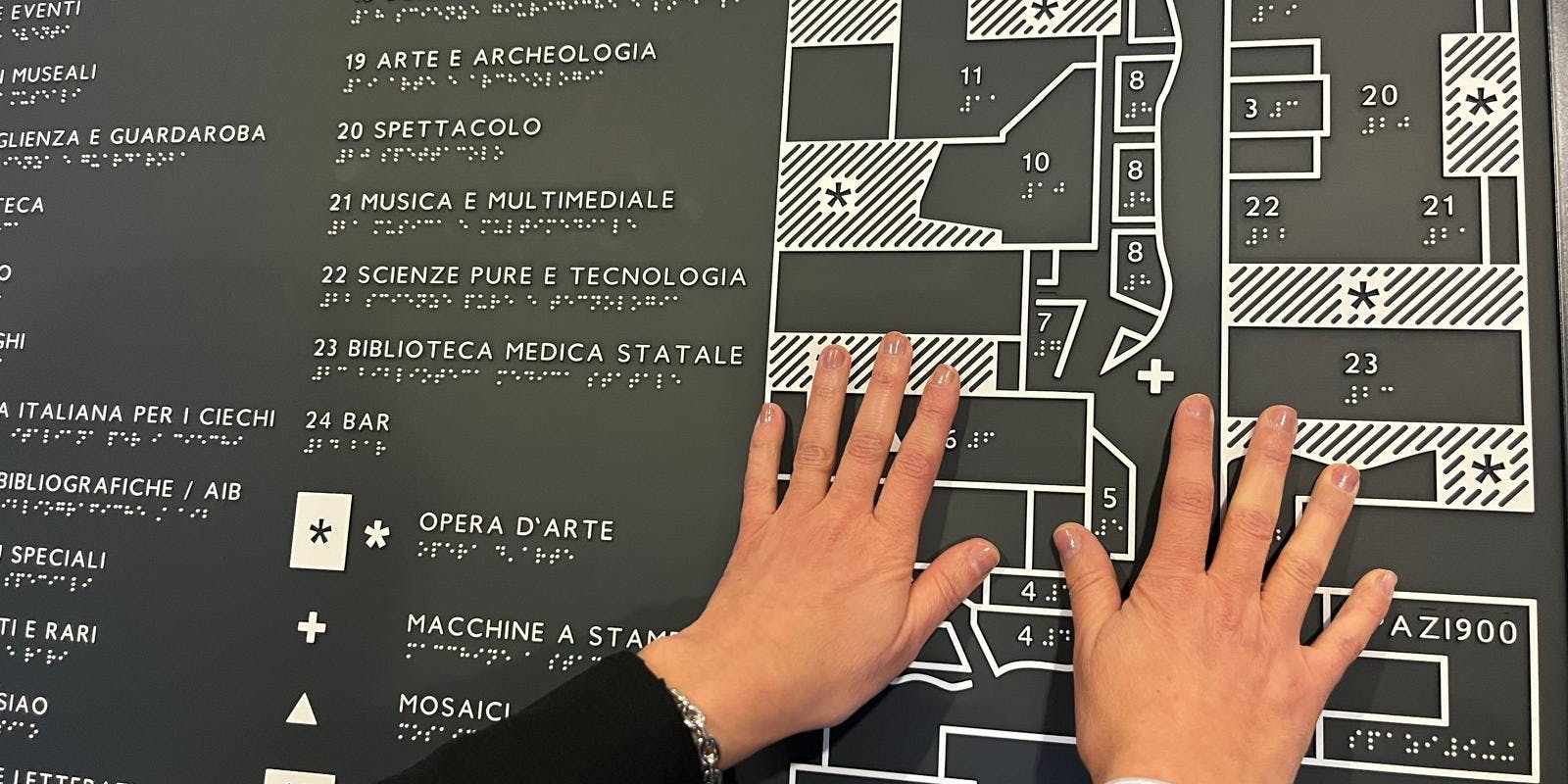
Indeed, even the organization of spaces plays an important role: stations must be easily reachable thanks to floor signage, while visual indications should be clear, with large characters, good color contrast and placed at an adequate height. To facilitate orientation, tactile maps highlighting points of greatest interest could be installed.
For deaf people, it would be useful to provide videos in Sign Language, even international, illustrating how the services work. At the same time, it is important to train staff on the use of applications for transcribing spoken words into written text, such as Google’s "Live Transcribe". These applications could be installed on a tablet available to the responsible staff.
Regarding motor disabilities, it is essential to guarantee accessible stations, with adequate heights both for consultation and for requesting information. Finally, for people with cognitive disabilities, it is important to offer materials in Alternative Augmentative Communication and to provide simplified versions of informational content, both paper and digital.