"Operatori culturali per l'inclusione"
Educational proposals, methodologies, and results of a visionary project
by Fabrizio Serra, Gabriella Damilano
Why train museum staff in inclusive approaches?
Fifteen years ago, we started precisely with this question to address a specific training need identified in the area and with the explicit goal of disseminating and reinforcing a principle increasingly recognized socially today, namely that culture belongs to everyone, but it is also for everyone.
From the beginning of the activities, the focus has been on a very broad target, namely all museum staff and, since 2018, cultural services in general, without distinction of roles and functions carried out within the organization, with the deep conviction that every resource, regardless of the position held, contributes to building the reputation of the place where they work.
We are always certain that a distinctive style in terms of welcoming diverse audiences can only be recognized through the widespread and collective adoption of an open and inclusive, welcoming and attentive perspective promoting every person.
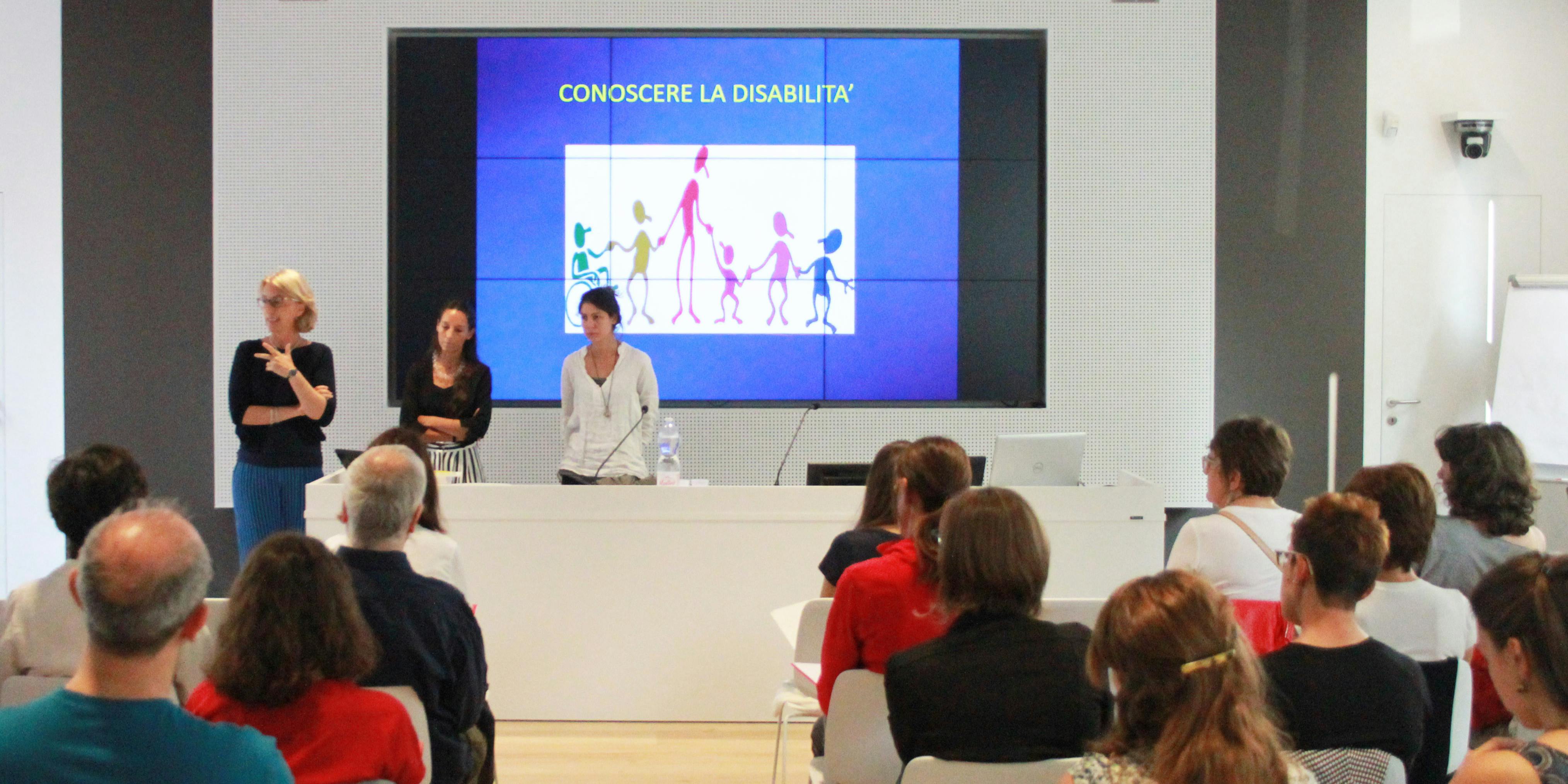
Therefore, we have worked to strengthen the transversal skills of all operators, from ticket office staff to directors, proposing introductory training initiatives aimed at:
- deconstructing stereotypes about people with disabilities,
- acquiring updated knowledge about disabilities,
- implementing and consolidating relational and welcoming skills for diverse audiences.
Subsequently, seminar deepening sessions were offered, often workshop-based, which allowed participants to develop specific technical skills, design and manage activities for all, designed precisely based on the needs of people with disabilities.
The central focus has been the themes of relationship and hospitality, aware that it is from the first encounter between the visitor and the museum or cultural reality that the pleasantness of an experience may depend. If from their experience in museum and cultural services people are able to perceive the recognition of the legitimacy of their needs, and the consequent welcoming of them, the professional mandate of the operators, both individual and collective, can be considered fulfilled beyond the mere transmission of artistic and/or cultural contents.
In the past, the term accessibility predominantly referred to the structural and architectural level, but the changes in the socio-cultural context have fostered the spread of a perspective more interested in the theme of accessibility to places of art and culture, understood as the ability to involve all audiences. Much effort has been made to identify strategies to make cultural and artistic heritage increasingly shared and shareable, contributing to building an open, inclusive society attentive to promoting well-being and health.
The numbers of the project, which since 2022 has taken on the new name Cultural Operators for Inclusion, clearly show the steps taken in this direction through the multiple initiatives carried out in training, cultural and editorial fields. Regarding the training plan from 2012 to 2025:
- about 550 institutions among museums and cultural services of our country have joined the project;
- more than 1,550 cultural operators have participated in training initiatives;
- 53 editions of the basic course have been activated;
- 45 thematic deepening training activities have been carried out;
- 4 workshops for management positions and 4 workshops for the development of for all project designs have been conducted.
At the national level, more than 60 experiences have replicated the design and delivery of training activities inspired by the Turin model.
On the cultural front, a first volume (Serra, Tartaglia, Venuti, Carocci, 2017) was published in 2017 aiming to illustrate the operational model and narrate the first years of the project's experience, and in 2025 a second volume (Various authors, edited by Serra, Tartaglia, Venuti, Carocci, 2025) aims to share the results and horizons of this extraordinary training enterprise.
From 2017 to 2025, 3 conferences [1] were also organized aimed at disseminating the value perspective based on inclusion and participation, starting from the already mentioned principle that art is everyone’s heritage, that is for people of all ages, genders, and cultures, but at the same time aware of how the conditions deriving from disability can cause experiences of alienation from the world of art and culture.
What ingredients have allowed these results to be achieved over time?
First the choice of a shared design approach from the ideation phase, maintained afterwards through monitoring, final evaluation and continuous redesign, fueled by participants’ feedback, thus confirming the methodological premise of the project. In a slogan, accessibility is participation of the initiative’s recipients as well as indirect beneficiaries.
A second determining factor for the successful outcome of the proposed activities was the choice of didactic-training methods aimed at promoting and enhancing learning from experience as well as the direct involvement of participants, combining theoretical contributions with what was learned experientially.
The third pillar was represented by the challenge of a training proposal addressed to all operators, without any distinction of roles and functions, aimed at enhancing knowledge and relational skills deployable at every stage of the encounter with the public, from ticket purchase to guided tour.
The general objective of the project, i.e. to promote a culture of inclusion and hospitality for visitors with disabilities and special needs, can be further broken down into the following specific, sequential objectives: improve knowledge of different disabilities and related needs; adapt relational and reception skills of services through learning methods, strategies and attitudes that foster comfort conditions for all audiences; better manage communication toward all users, as the ability to meet specific needs makes the structure more flexible and capable of adapting communication to all; qualify operators working in cultural services, through a provision of knowledge and relational skills that constitute an added value; make the museum or cultural structure truly inclusive and integrated into its organization and offerings.
A flexible, permeable, dynamic planning logic capable of addressing the complexity of training contexts and promoting negotiation among different points of view of the actors involved in implementing activities was applied to the project.
Organizing and conducting training interventions with adults already working requires deploying a rich set of devices able to suggest and facilitate learning mechanisms through didactic methods linked to active pedagogy. Training strategies aim to listen to individual and collective experiences, properly guided and offering evidence of the theoretical contributions illustrated, points for reflection, questions, professional prompts. Certainly, contents related to hospitality and relationship allow for an immediate intertwining of theory and practice.
Great importance has always been given to analyzing feedback collected from participants, paying attention to achieving maximum involvement of interested parties. Within this framework, at the end of 2021, on the occasion of the celebration of the project's first ten years of activity, a large follow-up study investigated and measured the impact generated by the training initiatives carried out up to that moment, aiming to take stock of the results achieved and define horizons to direct the project's future.
Through the involvement of over 200 cultural entities, the changes triggered in services have thus become visible through the transformation of their operators following participation in training initiatives. A transformation triggered in the perspective, sensibilities, attitudes and subsequently implemented by adopting new operational approaches, organizational processes and more inclusive tools. The research included the construction and implementation of targeted and distinct tools and actions by target and purpose: a massive survey conducted with a questionnaire sent to all course participants, interviews with opinion leaders, focus groups for deepening, collection of particularly significant narratives and perspectives.
The results of the research conducted between April and July 2021, gathered in a report presented at the conference Welcomed as Art. Museums and cultural places for inclusion (May 2022), highlighted that the goals recognized by participants as achieved share the word 'change': in the mindset, regarding the vision of disability finally understood not as a discriminating factor but as an individual characteristic of the person; in the organizational culture, regarding the themes of inclusion and hospitality; in the design model of processes, tools and activities, increasingly inclusive and designed for all, therefore conceived from the start for all audience types and not subsequently adapted for special needs.
The path is not over, but the direction is clear, convincing and now widely shared.
[1] Museums towards a culture of hospitality, Fondazione CRT, Turin 2017; From art for all to art of all. Towards a new accessibility perspective, Officine Grandi Riparazioni, Turin 2018; Welcomed as Art. Museums and cultural places for inclusion, Officine Grandi Riparazioni, Turin 2022.
To learn more
Serra F., Tartaglia F., Venuti V., Operatori museali e disabilità. Come favorire una cultura dell’accoglienza, Carocci Editore, Roma 2017.
Serra F., Tartaglia F., Venuti V., a cura di, Partecipazione e accessibilità. Costruire contesti for all in ambito culturale, Carocci Editore, Roma 2025.